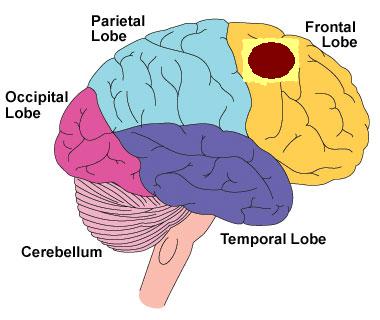
- On January 18th I had a seizure in the dressing room after a hockey game. I had a CT scan done at the Misericordia Hospital that night, which detected a faint spot on the right side of my brain.
- I was sent for an MRI the next day which revealed that I did in fact have a lesion which they suspected to be a Meningioma brain tumor (more on Meningiomas later).
- In the picture to the right, the red circle more or less marks the spot where my tumor was located. My tumor was a convexity Meningioma located over frontal lobe of my brain.
- On January 27th with the tumor still in my head and putting pressure on my brain, I had another seizure at work.
- Between January 27th and my surgery date of February 9th, I moved back in with my parents as my surgeon had me quite doped up on pre-surgery drugs.
- On February 9th, my brilliant neurosurgeon Dr. Max Findlay at the U of A successfully removed my entire tumor.
- Two days later I was discharged and went back to my parents' home to recover. The weird thing was that as the weeks went on, I didn't seem be feeling better. But what did I know? I'd never had brain surgery before. I thought that maybe that's just how it goes and that it takes a long time to recover from a surgery of this nature. Even my family doctor who I went and saw wasn't too concerned and told me to "hang in there".
- March 5th was the straw that broke the camel's back. I could not stand up without my whole left side going numb, so off to emergency I went.
- After an 11 hour wait in the emergency room at the U of A, I finally got to speak to a resident. Our conversation went something like this:
Me: I had a Meningioma removed...yada yada...I haven't been feeling well since the surgery, and now I'm getting numbness on my left side when I stand up.
Resident: That's strange. (He proceeds to do a few simple tests on me...squeeze my fingers...reflex tests, bang my knees with a mallet, etc.)
Me: Is it possible that I have an infection?
Resident: Well, I don't see any puss coming out of your incision site. If you had an infection, there would be puss, as that is a sign of infection (no shit Sherlock). We could swab your incision site and send it to the lab, but the results won't be back for 48 hours (I would have been sent home until the test results came in).
Me: Well can I expect this sort of numbness after a brain surgery like mine? Is this a sign of my brain healing?
Resident: I'm really not sure.
Me: What do you mean you're not sure? Don't you study this sort of stuff in med school when you're training to become a neurosurgeon?
Resident: Oh, I'm not training to be a neurosurgeon. I'm going for my GP and am just doing a one month rotation through neurosurgery.
Me: (At this point I'm very firm and angry) No offense, but you're not the person with whom I wish to speak with. I want to speak with an actual neurosurgeon, and I'm not leaving this hospital until I do.
- The staff at the hospital got the point and found me a gurney to sleep in overnight. The next morning I saw the neurosurgeon on call. He asked me a few questions and proceeded to press on my incision, at which point the skin broke and puss oozed out like toothpaste. "Wow" he said, you definitely have an infection and we need to get you in for another surgery to clean that out STAT.
- 6 hours later, Dr. Robert Broad, another wonderful surgeon at the U of A, opened up my original incision and completely cleaned out my infection.
- Subsequent to this second surgery I was fitted with a PICC Line. A PICC line is catheter which is inserted into a peripheral vein, and then advanced through increasingly larger veins, toward the heart until the tip rests up near the heart. The PICC line was inserted so that I could have intravenous liquid antibiotics injected into my body over a course of 8 weeks. This was to make sure the infection didn't come back. The part of the PICC line sticking out of my arm was connected to a small pump and liquid
antibiotic bag (the bag would get changed every 2 days). I lugged the bag and pump around in a small fanny
pack. The pump would deliver the antibiotics into my system at programed intervals. Here is a picture of a PICC line (http://thatcancerstuff.com/images/cannula.gif.). The pump plugs into the Cannula, and the antibiotic bag plugs into the pump.
- The next step was radiation therapy. The pathology report for my Meningioma revealed that it was primarily bland throughout, however there were a few small sections that had some more aggressive characteristics. Protocol in this situation is to treat the tumor as being aggressive rather than bland, just in case there are any microscopic cells kicking around that could eventually regrow into another tumor. So, off I went to the Cross Cancer Institute for radiation therapy.
- The Cross carefully planned a radiation treatment program that focused solely on delivering radiation to the area where my tumor had been located.
- I had a six week radiation course, every Monday - Friday, from May 17th to June 29th, Radiation is completely painless and each session took about 5 minutes.
- On July 8th, I had another seizure while sleeping at 3:30 a.m. My doctors had advised me that there was a definite possibility that this could happen within the month following my radiation therapy. The reason being is that this time period is a prime time for swelling of the area of my brain that had received radiation. Coincidentally my body had metabolized the anti-seizure medication that I'm on, meaning it had fallen below it's required therapeutic level. Those two things combined caused the seizure.
- At the advise of my oncologist, I was put on a cortical steroid called Decadron for one month. What this drug does is seek out and reduce swelling within the body (in my case my radiation treatment area). The downside of Decadron are its severe side effects; most notably insomnia, which I definitely experienced for a full month. I just finished the Decadron on August 12th and am now working with my family doctor on get my sleeping pattern back to normal. I'm pleased to report that my sleeping pattern is improving. My anti-seizure drugs have also been brought back up to therapeutic levels.
- You may wonder why I'm on anti-seizure medications now that the tumor is gone. The fact is that the area where my tumor was located has created a small indentation in my brain. In time this indentation should go back its original shape. However in doing so, this could cause irritation, and hence a seizure. So at the advice of my neurologist, I'm on an anti-seizure medication for at least a few years. The good thing about this medication is that I've not experienced any side effects. I will simply have to go for blood work every month to make sure my dose is within the therapeutic range. In my view it's a very effective drug. I'd been seizure free from February 9th to July 8th. So it seems the key is to just keep tabs on making sure it's always within the therapeutic range.
| |